
What was the NEEM Project in Greenland between 2007 and 2012?
The NEEM Project—North Greenland Eemian Ice Drilling—was a major international ice-core project conducted in northwestern Greenland from 2007 to 2012. Its central goal was to drill through roughly 2.5 km of the Greenland Ice Sheet and recover ice dating back to the Eemian interglacial, about 130,000–115,000 years ago.
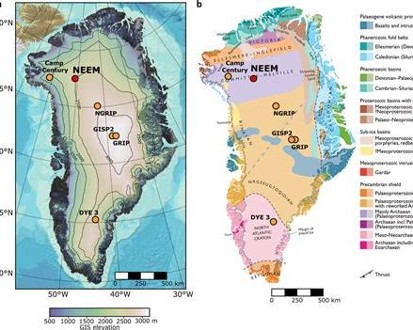
The Eemian was especially interesting because it was warmer than the present climate, making it a valuable natural analogue for studying how Greenland’s ice sheet might behave in a warmer future. Earlier Greenland ice cores had not yielded a clean, continuous Eemian record: the oldest layers near the bottom had been melted, folded, or otherwise disturbed by ice flow. Scientists therefore selected the NEEM site at about 77.45° N, 51.06° W, using radar measurements to find an area where they hoped older ice would be better preserved.
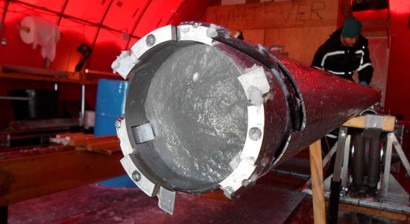
The field programme unfolded over several summers. In 2007, equipment was hauled over the ice from the earlier NGRIP drilling site. The NEEM camp was constructed and drilling began in 2008; intensive drilling and ice-core processing followed from 2009 onward. In July 2010, the drill reached the bottom of the ice sheet at about 2,537 metres, with additional work on basal ice and sediment continuing afterward. The deep-drilling programme formally ended in 2012. During peak seasons, around 30–40 scientists and technicians lived at the remote camp for several months.
Scientists analysed the core in several ways. Oxygen and hydrogen isotope ratios provided estimates of past temperature and precipitation; dust and chemical impurities recorded atmospheric and environmental conditions; trapped air bubbles preserved samples of the ancient atmosphere and greenhouse gases; and ice-crystal structure, borehole temperature, biological material and other measurements helped reveal the behaviour of the ice sheet itself. Research groups from 13 countries participated.
The most important result was somewhat unexpected. The deepest Eemian ice was folded and disturbed, rather than forming the perfectly ordered sequence researchers had hoped for. Nevertheless, the team was able to reconstruct much of the climate history by matching chemical and isotopic markers between the folded layers.
That reconstruction, published in Nature in 2013, indicated that around 126,000 years ago, temperatures at the NEEM site may have peaked at roughly 8 ± 4 °C warmer than the mean of the past millennium. Despite that warmth, the northwest Greenland ice sheet at the site apparently thinned by only about 400 ± 250 metres between approximately 128,000 and 122,000 years ago. The ice also showed evidence of substantial surface melting during the Eemian.
So, in simple terms, NEEM was an attempt to use a 2.5-km-long cylinder of ancient Greenland ice as a time machine: researchers wanted to see how Greenland responded the last time Earth’s climate was substantially warmer than recent historical conditions. Its results became an important constraint on reconstructions of the Eemian climate and on estimates of how the Greenland Ice Sheet—and therefore global sea level—can respond to warming.
Google answer to “Eemian interglacial”
The Eemian interglacial was a warm period approximately 130,000 to 115,000 years ago, marked by higher global temperatures and sea levels than today.
Timing and Nomenclature
The Eemian interglacial, also known as the Last Interglacial, occurred between roughly 130,000 and 115,000 years ago, following the Saale Glacial Stage and preceding the Weichselian (or Wisconsinan) Glacial Stage. In different regions, it is referred to as the Ipswichian in Britain, the Riss-Würm in the Alps, the Mikulino in Russia, and the Sangamon in North America. The name “Eemian” originates from the River Eem in the Netherlands, where the interglacial deposits were first studied.
Climate Characteristics
During the Eemian, global temperatures were generally 2–4°C higher than present, with some Arctic regions, such as northwestern Greenland, experiencing local warming of up to 8–8.5°C above pre-industrial levels. Atmospheric CO2 concentrations were around 280 ppm, similar to pre-industrial levels. The climate was warmer and more moderate than today, leading to extensive melting of ice sheets and a largely ice-free Scandinavia and Arctic Ocean.
Sea Levels and Ice Sheets
Sea levels during the Eemian were 6–9 meters higher than today, primarily due to partial melting of the Greenland and West Antarctic Ice Sheets. Despite significant warming, only about 10% of the Greenland Ice Sheet melted, indicating that even substantial warming did not trigger catastrophic ice loss. Marine deposits from this period show that seas extended further onto land, reshaping coastlines globally.
Flora and Fauna
The Eemian supported rich and diverse ecosystems. Temperate forests expanded widely, boreal and mixed deciduous woodlands dominated high latitudes, and Mediterranean taxa thrived in southern Europe. Fossil vertebrates indicate a varied mammalian fauna in Europe, including horses, bison, elephants, and cave bears. Marine molluscan assemblages suggest species distributions extended further north than today.
Paleoenvironmental Insights
Sediment cores, pollen records, and isotopic analyses reveal that the Eemian experienced alternating phases of environmental stability and rapid change, influenced by variations in insolation and ice-sheet dynamics. These records provide critical analogues for understanding how ecosystems, sea levels, and climate respond to warming, offering a reference point for current and future climate studies.
Significance
The Eemian interglacial is particularly important as a natural baseline for studying climate sensitivity, ice-sheet behaviour, and sea-level response under warmer-than-present conditions. It demonstrates that even with higher temperatures and elevated sea levels, ecosystems and ice sheets can remain resilient, providing valuable lessons for predicting future climate scenarios.
